At the core of professional education lies Reflective Practice. This is the systematic process of examining your thoughts, actions, and the different stages of the teaching and learning (T&L) cycle. By analyzing the full complexity of the classroom experience, we can understand not just what happened, but why it happened—and how to improve it. Ultimately, reflective practice evaluates effectiveness, challenges personal assumptions, and bridges the gap between theory and practice in a cycle of continuous improvement.
Everything starts and develops from here. Reflective practice is the foundation of an educator’s professionalism. It offers the space to reflect on roles and responsibilities, aligns daily practice with Professional Standards, and ensures a high standard of quality and accountability.
While these theoretical concepts are vital to an educator’s vocabulary, the true challenge lies in translating them into practical strategies and tools that genuinely support our daily practice. To bridge this gap, I am proposing a new way to look at reflective practice—an existential approach that embraces the true complexity of the teaching and learning process, while actively resisting a consumerist view of education.
When navigating a culture of continuous improvement, we often focus on quality assurance. If we consider the insightful definition of quality as “to travel hopefully, but never to arrive,” it becomes clear that we need a reliable compass. Making reflective practice visible is what allows our pedagogical map to unfold. When the reflection process is tangible, the experience of both tutors and students is deeply enriched.
To capture the complexity of the learning experience, we need a tool that translates it holistically through sensory engagement. Imagine a kaleidoscopic form of documentation that offers a variety of entry points for insight and diverse means of engagement. This inclusive approach benefits learners at all levels and is particularly powerful for respecting and promoting neurodiversity. If we agree with Marshall McLuhan that “the medium is the message,” then the specific tool we choose for reflective practice has the direct power to either hinder or enhance our understanding.
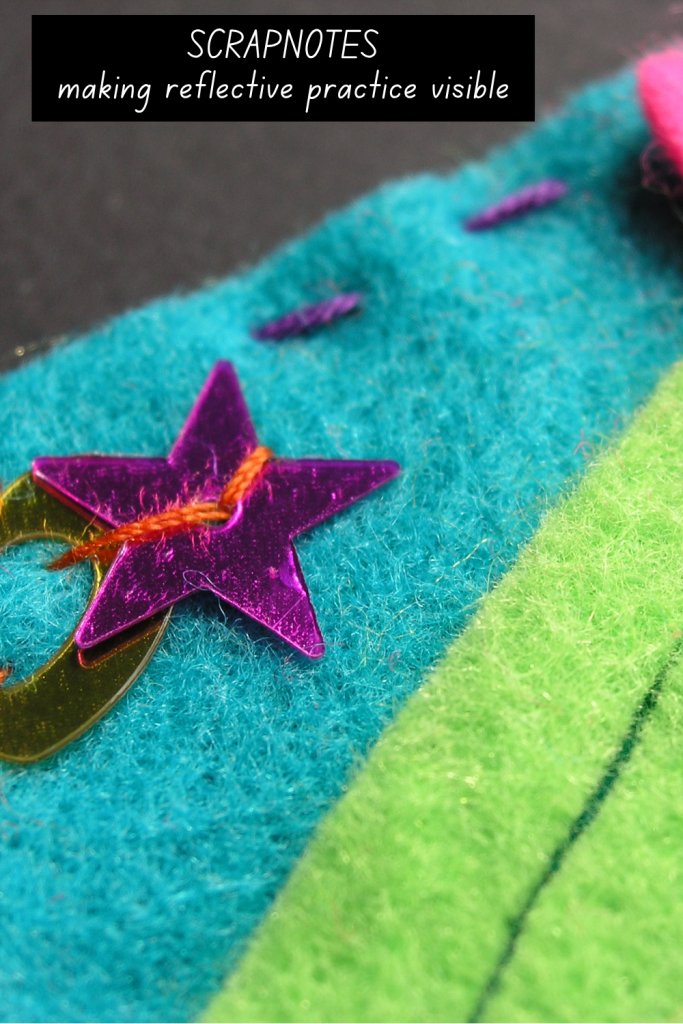
The core concept is wonderfully simple: we use scrapbook techniques, modes, and inspirations as alternative methods to document the teaching and learning journey and provide evidence of reflective practice. The Cambridge Dictionary defines a scrapbook as “a book with empty pages where you can stick newspaper articles, pictures, [and] scraps of materials that you’ve collected and want to keep.”When applied directly to the documentation of reflective practice, this concept becomes SCRAPNOTES.
SCRAPNOTES is the active process of tracking the teaching and learning experience by creating a multimodal record of the key moments, insights, and evocative images collected along the way. By encouraging us to look back meaningfully, it unlocks opportunities for deeper reflection, connection, and growth.
It is, quite simply, about making your mark—leaving a trace, and rendering the invisible journey of reflective practice beautifully visible.
“To make a mark is to say: I was here. I felt this. I understood. It is the ultimate human act of transforming a fleeting moment into an enduring touchstone.”
SCRAPNOTES is your canvas. Make your mark, leave your unique trace, and let your teaching legacy unfold beautifully on the page.