ARTSIDEDOWN: Reimagining Education Through Art
I view learning and education as powerful catalysts for individuals to become the true protagonists of their own lives and proactive authors of their own existence. Art plays a crucial role in this transformation. By turns provoking, astonishing, incomprehensible, or shocking, contemporary art refuses to let us remain indifferent. Whether an artwork delights or disgusts us, it invariably forces a reaction—compelling us to reconsider our deeply held principles and perspectives.
In this way, art becomes a metaphor and the launchpad for extraordinary journeys of discovery. Colors, shapes, materials, and techniques vocalize contemporary issues, echoing modern doubts and anxieties. Rather than providing easy answers, art acts as a generator of infinite questions, fueling a desire for personal research, growth, and development. Best of all, approaching an artwork in this manner requires no prior artistic knowledge; it is universally accessible.
One Artwork, Endless Interpretations
ARTSIDEDOWN is a unique methodology I devised that leverages the power of artworks to offer an unconventional, transformative approach to learning.
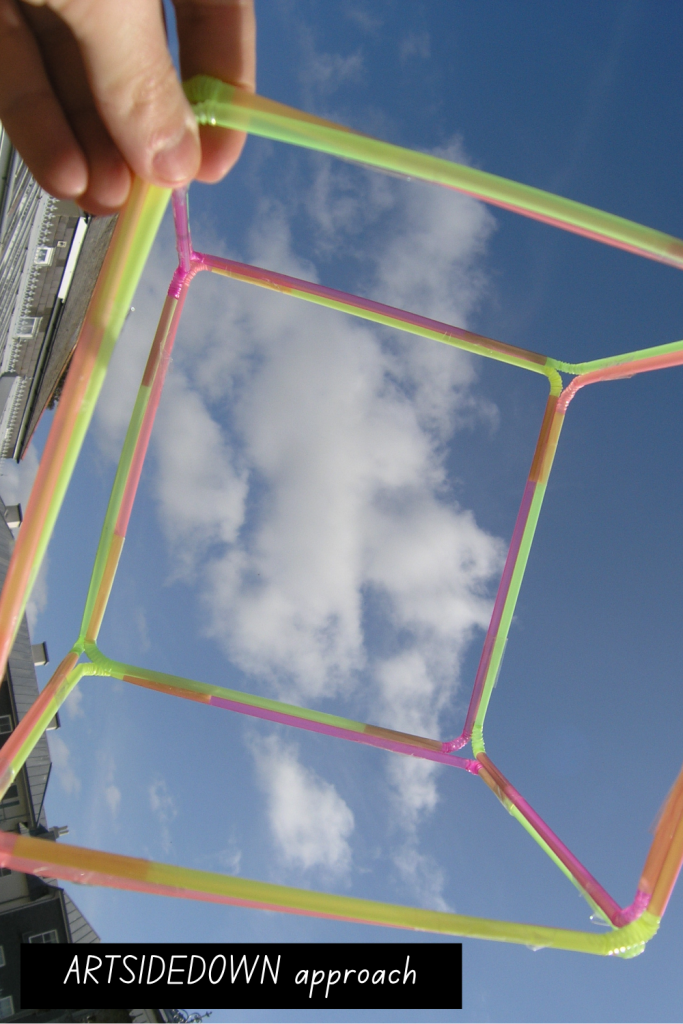
I like to view every piece of art as a Rubik’s Cube. You can twist it, disassemble it, and reassemble it over and over again, constantly revealing new faces and diverse combinations of meaning. A meaningful educational journey must embrace this philosophy, passing the thrill of turning the cube’s faces onto the learners—whether children or adults.
Every artwork is a complex, multifaceted reality that offers a multitude of messages at different levels. It can be analysed simultaneously as a text, a pretext, a context, and a hypertext:
- Text: The artwork as it physically exists—its form, materials, and visual language.
- Pretext: The artwork as a catalyst or starting point for personal reflection and dialogue.
- Context: The historical, social, and cultural environment surrounding the artwork’s creation.
- Hypertext: The endless web of connections the artwork makes to other ideas, media, and lived experiences.
An artwork is rarely just one of these dimensions; it is potentially all of them at once. As educators, our duty is to help learners navigate these fluid layers of interpretation and capture the questions that surface. We do not provide the answers; instead, we guide them to experiment creatively as they uncover their own personal responses.
Crucially, I firmly believe that educators must experience this transformative process firsthand. Only by diving into the experience ourselves can we truly and profoundly understand how to unveil the Rubik’s Cube hidden behind every piece of art.